
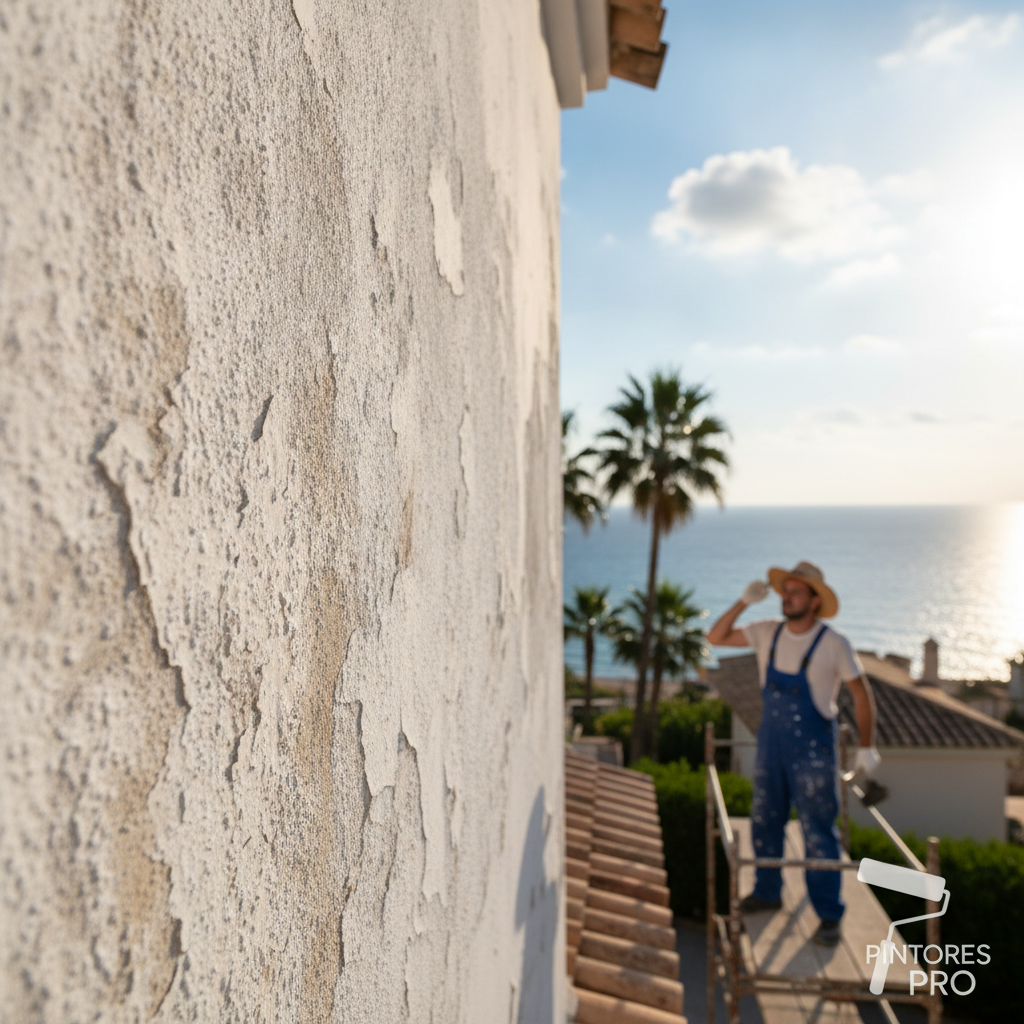
Living on the Costa del Sol is a privilege that many homeowners across the globe envy. From the sun-drenched beaches of Marbella to the charming hills of Estepona and the vibrant streets of Malaga, the Mediterranean lifestyle is unparalleled. However, the very proximity to the sea that makes this region so desirable also presents a significant challenge for property maintenance: saltpeter. For homeowners and property managers, understanding how this mineral deposit interacts with masonry is crucial before embarking on any renovation project.
At Pintores Pro, we have spent years transforming villas and apartments across the coast. We often encounter clients who have attempted DIY painting projects or hired inexperienced contractors, only to find their beautiful new walls peeling within months. The culprit is almost always the same. If you are considering a fresh coat of paint, you must ask yourself: What problems does painting over a surface with saltpeter cause on the Costa del Sol?
Saltpeter, known scientifically as efflorescence, is a crystalline deposit of salts that forms on the surface of brick, concrete, and stone. On the Costa del Sol, this phenomenon is exacerbated by the high levels of salinity in the air and the characteristic humidity of the Mediterranean climate. When moisture penetrates porous building materials, it dissolves internal salts. As the wall dries, the water evaporates, leaving the salt behind as a white, powdery, or crusty substance.
To understand the technical chemical process behind these deposits, you can refer to the scientific definition of efflorescence. It is not merely a surface stain; it is a symptom of moisture migration that can compromise the integrity of your finishes.
Painting directly over saltpeter is one of the most common and costly mistakes a homeowner can make. Because the Costa del Sol experiences high temperatures followed by humid nights, the pressure exerted by these salts is constant. Here are the primary issues that arise when you ignore the presence of saltpeter:
Paint requires a clean, stable surface to bond effectively. Saltpeter is essentially a loose powder. When you apply paint over it, the paint sticks to the salt crystals rather than the wall itself. As the salt naturally shifts or expands with moisture, the paint layer loses its grip and begins to flake or peel in large sections. This results in a "hollow" look where the paint hangs loosely off the substrate.
The salts are hygroscopic, meaning they actively attract moisture from the atmosphere. Even if the wall looks dry when you paint it, the salt trapped beneath the paint film will pull moisture in. This trapped water eventually turns into vapor when the Spanish sun hits the wall, creating pressure that forces the paint to bubble and blister. These unsightly bumps eventually burst, leaving your villa looking neglected.
Saltpeter is chemically aggressive. It can react with the pigments in low-quality or even mid-range paints. This often results in yellowish or brownish stains that bleed through the new coat of paint. No matter how many layers you apply, the salt will continue to migrate to the surface, bringing these discolorations with it and ruining the aesthetic appeal of your apartment or villa.
The problems are not just aesthetic. If saltpeter is trapped behind a non-breathable paint, it undergoes a process called subfluorescence. This is when the salt crystals grow within the pores of the masonry itself. The pressure generated by this crystal growth is strong enough to crumble the internal structure of the plaster or render. Eventually, you won’t just be repainting; you will be forced to strip the walls down to the brickwork for expensive repairs.
At Pintores Pro, we understand that the Costa del Sol requires specialized techniques. We don’t just "cover up" problems; we solve them. Addressing saltpeter requires a rigorous multi-step process that ensures a long-lasting and beautiful finish for your property.
First, our team identifies the source of the moisture. Is it rising dampness from the ground, or is it sea spray penetrating the facade? Once the source is addressed, we perform a deep mechanical cleaning to remove all visible salts. This is followed by the application of neutralizing acids that stabilize the pH of the wall and stop the chemical reaction of the salts.
Finally, we use high-quality, breathable primers and silicate-based paints. These products are specifically designed for coastal environments. They allow the wall to "breathe," letting moisture escape as vapor without pushing the paint off the surface. This is the only way to ensure that your home remains vibrant and protected against the harsh Mediterranean elements.
The temptation to quickly paint over white spots to prepare a villa for the summer season is high, but the consequences are guaranteed. Now that you know what problems painting over a surface with saltpeter cause on the Costa del Sol, you can see why professional intervention is necessary. From peeling and bubbling to serious structural damage, the "quick fix" always ends up being the most expensive option in the long run.
If you own a property in Marbella, Fuengirola, Benahavís, or anywhere on the Costa del Sol, trust the experts who know the local climate. Pintores Pro offers specialized painting services for houses, villas, and apartments, focusing on durability and excellence. Don't let saltpeter ruin your investment—contact us today for a professional assessment and a finish that stands the test of time.

 Español
 English
 Русский