
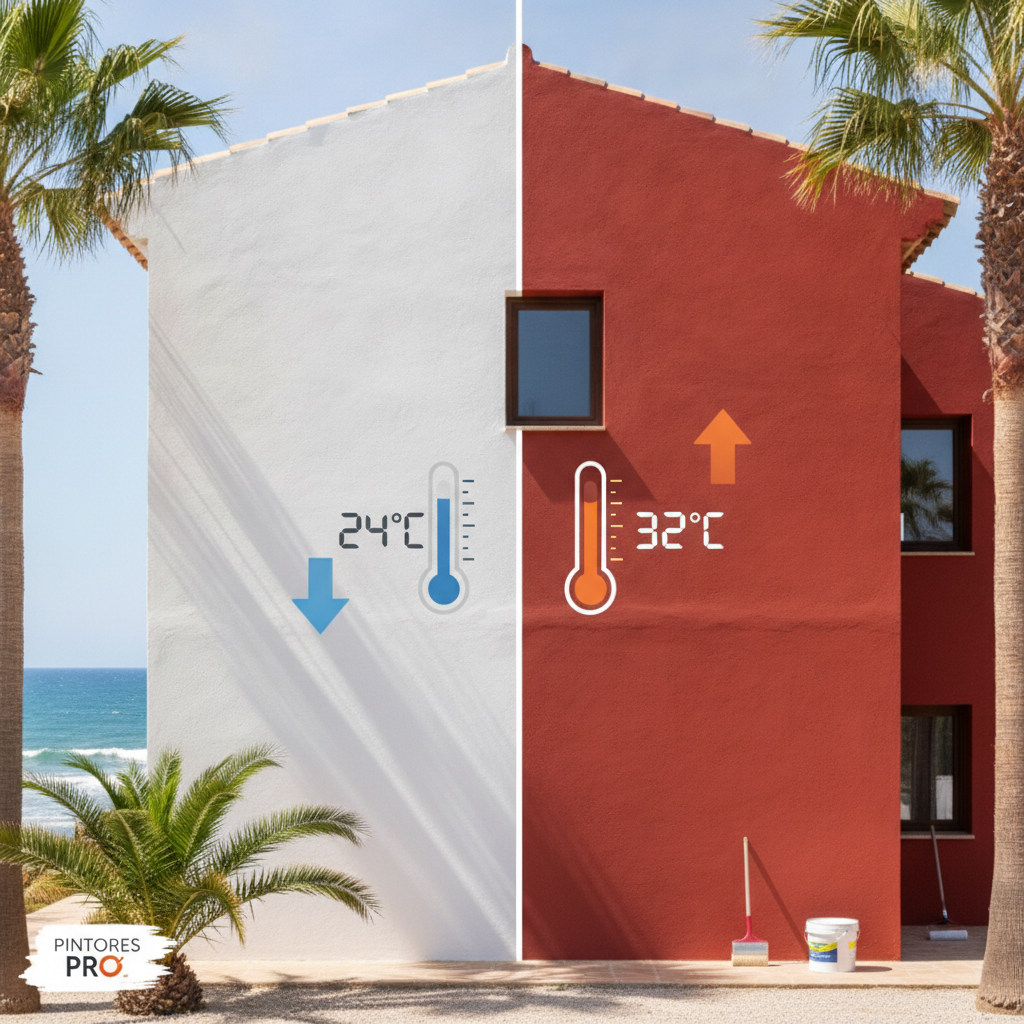
Living on the Costa del Sol offers an unparalleled lifestyle, defined by azure waters, world-class golf courses, and an abundance of sunshine. However, for residents of Estepona, the Mediterranean climate also brings the challenge of managing intense summer heat. While air conditioning is a common solution, savvy homeowners are increasingly looking at passive cooling methods to improve comfort and reduce energy costs. One of the most effective, yet often overlooked, factors in home temperature regulation is the exterior paint of the building.
At Pintores Pro, we have spent years transforming villas and apartments across Estepona. We have seen firsthand how a simple aesthetic choice can have a profound impact on the livability of a home. Choosing the right shade for your exterior is not just about curb appeal; it is a strategic decision that affects your indoor environment and your monthly utility bills.
The primary way the color of your facade affects your home is through a physical principle known as solar reflectance, or the "albedo effect." In simple terms, this refers to the ability of a surface to reflect sunlight back into the atmosphere rather than absorbing it as heat. When sunlight hits your home’s exterior walls, the pigments in the paint either bounce that energy away or soak it up. This absorbed energy is then conducted through the wall materials—such as brick, stone, or concrete—and eventually radiates into your living spaces.
In a sun-drenched location like Estepona, the difference between a dark facade and a light one can be staggering. Research suggests that dark-colored external walls can absorb as much as 70% to 90% of the radiant energy hitting them. In contrast, traditional white or very light-colored surfaces reflect the majority of this energy. This physical interaction is the fundamental answer to the question: How does the color of the facade influence the interior temperature of your home in Estepona? By choosing a high-reflectance color, you are essentially putting a thermal shield around your living space.
In Mediterranean climates, the sun remains high and intense for several months of the year. During July and August in Estepona, the exterior surface temperature of a dark-painted wall can reach over 60 degrees Celsius (140 degrees Fahrenheit). This heat does not stay on the surface; it migrates inward. This process, known as thermal bridging, means that even with high-quality insulation, a dark exterior will eventually cause the interior walls to warm up, forcing your air conditioning system to work significantly harder.
According to studies on building science and energy efficiency, such as those provided by the U.S. Department of Energy, "cool" exterior surfaces can reduce the peak cooling demand of a building by 10% to 15%. While these studies often focus on roofs, the same logic applies to the large surface area of your home's walls. In the narrow streets of Estepona’s old town or the sprawling luxury villas of the New Golden Mile, the color choice acts as a permanent, non-mechanical cooling system.
Beyond the immediate physical comfort, the financial benefits of choosing light exterior colors are substantial. Residents of Estepona are well aware of the rising costs of electricity in Spain. By maintaining a naturally cooler interior through reflective paint, you reduce the "run-time" of your HVAC systems. This leads to lower electricity bills and extends the lifespan of your cooling equipment, as it doesn't have to cycle as frequently to maintain a set temperature.
From an environmental perspective, the collective choice of light colors in a neighborhood can mitigate the "Urban Heat Island" effect. When many buildings in a concentrated area have dark surfaces, the local ambient temperature rises. By opting for traditional white or light beige—colors that are already iconic to the Andalusian landscape—homeowners contribute to a cooler microclimate in their specific community, whether that be in the heart of Estepona or a nearby urbanization.
While the classic "Pueblo Blanco" look is timeless and highly efficient, modern architecture in Estepona often calls for a more diverse palette. Homeowners sometimes worry that they must choose between a stylish, modern aesthetic and thermal efficiency. Fortunately, the painting industry has evolved. Pintores Pro works with advanced coatings that offer high solar reflectance even in mid-tone shades.
If you prefer something other than stark white, consider "cool" neutrals such as light grey, sand, or pale terracotta. These colors can still provide significant thermal benefits compared to dark blues, charcoals, or deep greens. When we consult with clients in Estepona, we help them select high-quality siloxane or acrylic paints that are specifically formulated to resist the harsh UV radiation of the Costa del Sol, ensuring that the color remains vibrant and the reflective properties stay intact for years to come.
Achieving the best thermal results is not just about picking a bucket of white paint from the hardware store. The application process and the quality of the product play a vital role. For a facade to effectively influence the interior temperature, the paint must be applied to a well-prepared surface to ensure maximum adhesion and uniform coverage. Gaps, cracks, or uneven application can create thermal weak points where heat can penetrate more easily.
At Pintores Pro, we specialize in the unique requirements of Estepona properties. We understand how the salty sea air and the intense sun interact with different paint chemistries. We use premium products that offer not only color stability but also breathability and moisture resistance. A well-painted facade protects the structural integrity of your home while keeping the interior cool and comfortable.
Understanding how the color of the facade influence the interior temperature of your home in Estepona is the first step toward a more comfortable and sustainable living environment. In a region where the sun defines our way of life, our homes should be designed to embrace the light without suffering from the heat. By choosing professional painting services and selecting colors that prioritize solar reflectance, you are making a long-term investment in your property’s value and your own quality of life.
If you are ready to refresh your villa or apartment and want to explore the best color options for the Estepona climate, Pintores Pro is here to help. Our team of experts provides professional guidance and flawless execution, ensuring your home remains a cool sanctuary throughout the Andalusian summer.

 Español
 English
 Русский